Women’s rights then and now: “As a country, we must consider whether public policy is formulated to make gender equality a reality.”
Date:
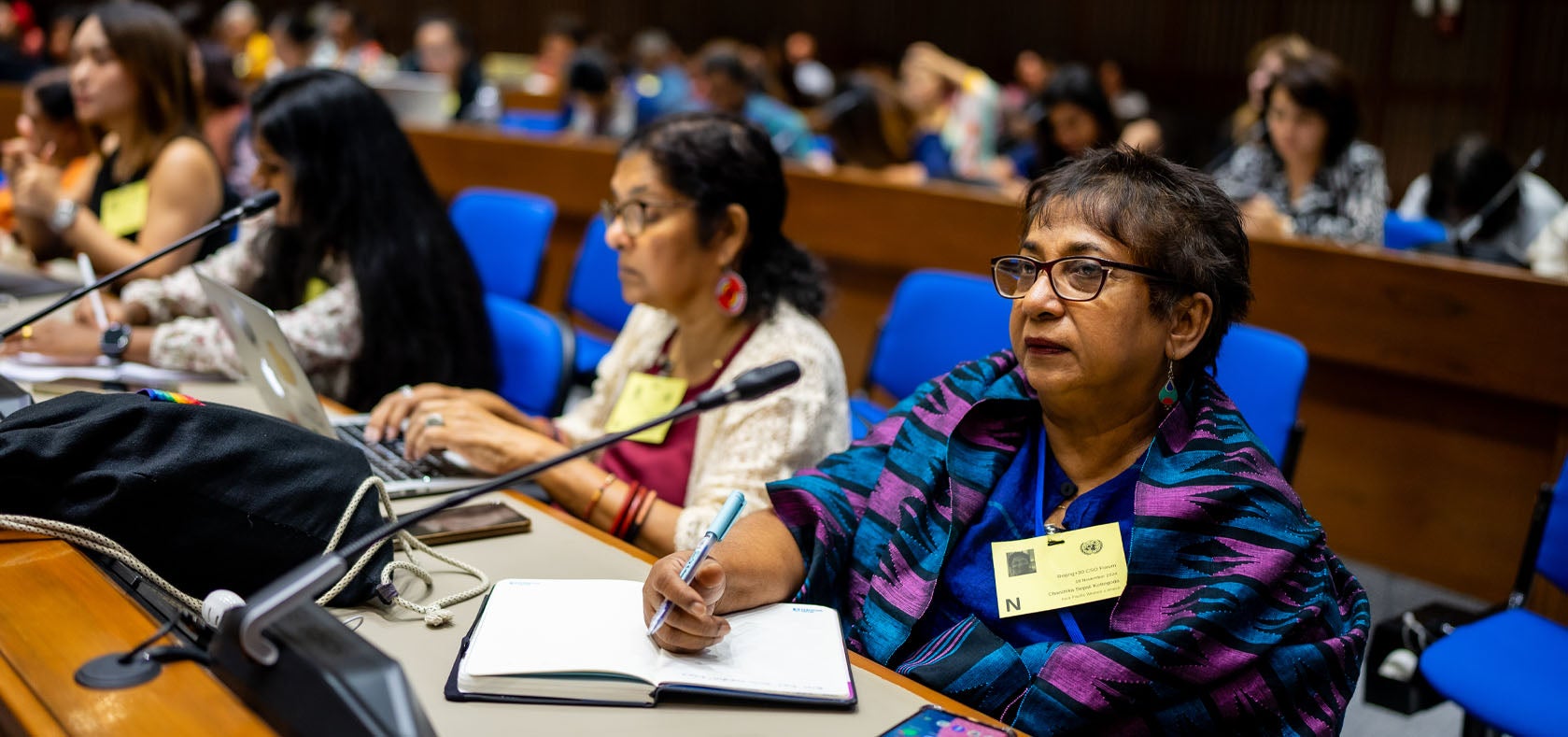
#ForAllWomenandGirls is a rallying call for action on the 30th anniversary of the Beijing Declaration and Platform for Action. Sepali Kottegoda, D.Phil, founder and Director of Programmes on Gender and Political Economy at Women and Media Collective in Sri Lanka, talks about how public policies can be designed to advance gender equality and fulfill the commitments of the Beijing Declaration and Platform for Action.
How did the Beijing Conference in 1995 influence the women’s rights movement in Sri Lanka?
In 1995, 60 women representing non-governmental organizations from Sri Lanka made their way to the Beijing Conference through the Sri Lanka Women’s NGO Forum coordinated by Women and Media Collective. This was the first time such a large group of women’s NGOs were able to attend such a global event focused on women’s rights. The experience was transformative. For many, it was the first time they realized that thousands of women from around the world shared the same struggles – that these issues were not isolated to our country, district, province, or village. Even now, 30 years later, the impact has been profound.
What role has the Women and Media Collective played in advocating for gender equality?
Women and Media Collective has actively, sometimes voraciously, conducted demonstrations on issues such as violence against women. I remember, around two and a half decades ago, there was a shocking gang rape of a woman in Sri Lanka. The media coverage was so biased and misinformed that it became clear we needed to counter these narratives and shed light on the underlying issues of oppressive social norms and expectations. Over the past 40 years, we have engaged in various forms of activism to protect women’s rights. These efforts have included advocacy against sexist advertising, raising awareness about diversity and sexual identity, and promoting women’s creativity in public discourse. As a result, Women and Media Collective is now widely recognized as an organization that does impactful work.
Women and Media Collective was also one of the key organizations in South Asia involved in the GEAR Campaign which advocated for the formation of UN Women - a crucial milestone within the UN system. At the Asia Pacific level, UN Women and The United Nations Economic and Social Commission for Asia and the Pacific have facilitated regional and intergovernmental dialogues with women’s organizations, fostering collaboration. UN Women’s research on unpaid care work and women's labour force participation in South Asia have been very valuable.
What challenges do women face in terms of employment and the gender pay gap?
Women's access to paid work is only one side of the story when it comes to the gender pay gap. Increasingly, we see a pattern where women searching for paid employment are being pushed into the informal sector where work is insecure, irregular and lacks retirement benefits. Many women find themselves without savings when they can no longer work or find paid employment. Family care responsibilities often compel women to leave or take time off from paid work. This results in the overall incomes of women being lower than that of men. Social norms further push women out of paid due to employers’ bias against maternal obligations. Creating employment opportunities for women is important, and challenging social norms must be considered during such interventions. Our research on unpaid care work highlights the need for childcare centres and a cultural shift to encourage men to equally share household responsibilities.
How has the recent economic crisis affected women in Sri Lanka?
The recent economic crisis has intensified the hardships faced by women. While much attention has been given to child nutrition, we must also recognize the impact on women’s nutrition. When food is scarce, women often eat the least. As the cost of living soars, their ability to provide quality care for their families has been severely compromised. Today, poverty remains alarmingly high.
How can public policy in Sri Lanka address gender inequality?
As a country, we must consider whether public policy is formulated to make gender equality a reality. For example, when it comes to financial aid given to households, we need to identify and analyse which family member is considered eligible, how is the money is utilized, and who truly benefits. Much of our taxation is indirect, leading to higher consumer prices that disproportionately affect low-income households. At the same time, investment in public services has continuously declined over the last 25 to 30 years. We must prioritize quality public services when considering the country’s investment needs. For example, the national health service is a lifeline for 30 to 40 per cent of the population. Privatization cannot create a level playing field for everyone. With the commitments to implementing the Sustainable Development Goals (SDGs), policymakers cannot shy away from Goal 5 on gender equality. The first-ever Time Use Survey by the Department of Census and Statistics highlighted how women and men spend their time, revealing the unequal distribution of household responsibilities, with women often bearing the greater share of unpaid care and domestic work. Such data provides critical insights for public policy.
What gives you hope for the future of women’s rights and gender equality in Sri Lanka?
The emerging voices of the younger generation representing diverse backgrounds, bring hope. Women-focused NGOs have brought visibility to women's rights and gender equality, creating more positive engagement. With younger voices, it is clear that they will not sit back and say ‘That's how life is and how our culture is’. More people are challenging these notions, saying ‘This doesn’t have to be’.
What advice do you have for those advocating for gender equality today?
Today, information is freely available. Staying informed is crucial, so to both younger and older generations, I urge: listen, talk to others, and understand how best you can contribute while recognizing the social norms that restrict progress. Communities can and do work collectively to create change. There is still a long way to go, but we are all on this journey together.